Artificial Intelligence Isn't the Job Destroyer. Lazy Leadership is.
(Yes, we know that’s a hot take headline…but bear with us…)
Every few weeks, another headline lands like a guillotine: thousands more jobs cut and AI cited as the reason. Entire entry-level pipelines are being quietly dismantled as executives point to AI and automation and simply shrug. On the surface, it looks like an inevitable technological reckoning: the machines are simply taking over.
But after decades of working with businesses of every size, from startups to Fortune 100s to government agencies, we at LEMA Logic see a very different picture. AI isn't destroying jobs. Organisational greed, short-termism, and a failure of imagination at the top are doing that. Technology is just the convenient excuse.
We've built our entire practice on a simple belief: people come first, always.
And right now, that belief puts us squarely at odds with how a significant portion of the corporate world is choosing to deploy AI. Because the truth is that artificial intelligence, applied thoughtfully and with genuine care for the people inside an organisation, is one of the most powerful job-creation and capability-amplification tools in history. The companies that understand this aren't just surviving the AI transition, they're pulling ahead of everyone else.
Coming Up In This Blog:
The Convenient Villain
When a corporation lays off 10% of its workforce and cites "AI-driven efficiencies," what they’re really saying is this: we have found a way to reduce our biggest cost (people) and the cultural moment makes it socially acceptable. Sam Altman, CEO of OpenAI, has even warned that companies are using what he calls "AI washing" to mask layoffs that are driven by other financial pressures entirely. Pandemic over-hiring, rising interest rates, shareholder pressure for leaner margins; all of these are real contributors to job losses that are being conveniently laundered through the narrative of technological inevitability.
This is not to say AI has no impact on the labour market. It clearly has and will continue to. A 2025 MIT study estimated that around 11.7% of jobs could already be automated. Anthropic's own CEO Dario Amodei has warned that half of entry-level office jobs may disappear by 2030. These are serious projections that deserve serious attention.
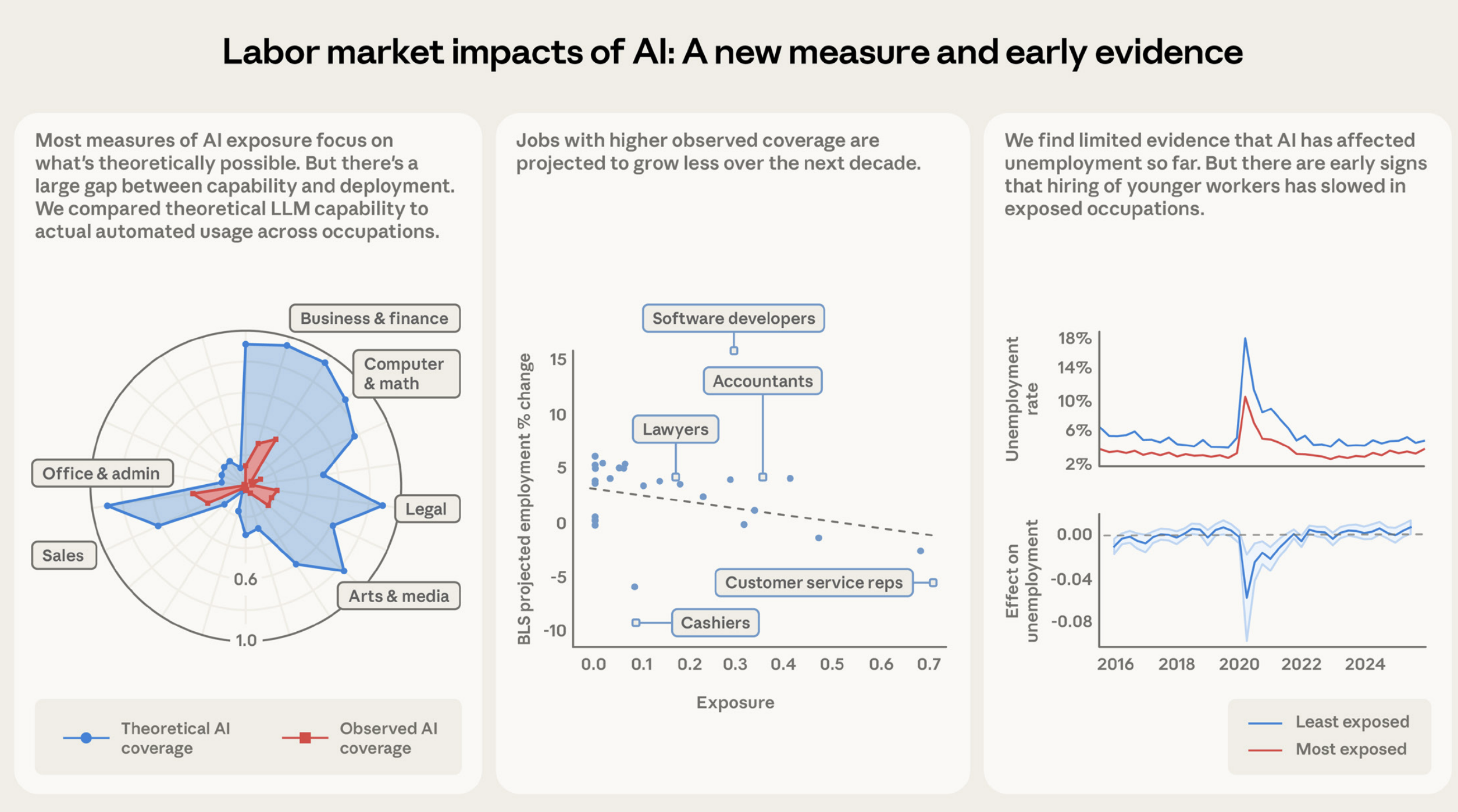
In the recent paper, Labor Market Impacts of AI, Anthropic also stated that the use of AI is far below its actual potential, and while there is little evidence of redundancies due to AI so far, there appears to be a slowing of hiring of new entry-level positions due to it.
But a projection about what AI could do is not the same as a mandate for what organisations must do.
The choice of how to deploy AI, and whether to use it to replace workers or to augment them, is a leadership decision, not a technological one. And too many leaders are taking the lazy, unimaginative way out.
A report from consulting firm Korn Ferry found that 37% of organisations plan to replace early-career roles with AI. One in three companies, looking at a generation of talented, adaptable young workers with better AI fluency than any cohort before them and choose to cut them loose. That is not innovation. That is abdication.
We see this pattern regularly in the AI space, and it frustrates us every time. Not just on behalf of the people losing their jobs, but because it represents a fundamental misunderstanding of what AI is actually for.
What IBM Is Doing
While much of corporate America races to shrink its workforce and call it progress, IBM is doing something that looks almost radical by comparison: it is tripling its entry-level hiring in 2026 across software development, cybersecurity, AI engineering, HR, and customer support, including in roles that AI is supposedly capable of filling on its own.
Nickle LaMoreaux, IBM's Chief Human Resources Officer, put it plainly at Charter's Leading With AI Summit in February 2026: "The companies three to five years from now that are going to be the most successful are those companies that doubled down on entry-level hiring in this environment. Not those that held the status quo or reduced it."
We couldn't agree more. IBM's logic is not naive optimism, it's exactly the philosophy we bring to every client engagement. LaMoreaux acknowledged that AI can now handle most of what entry-level jobs looked like two or three years ago, but IBM used that as a reason to rewrite every job, not to eliminate it.
Junior software developers no longer spend 34 hours a week on routine coding, they instead spend that time working with customers, building new products, and accelerating roadmaps. HR staffers no longer answer every standard query themselves, instead they supervise AI output, correct its mistakes, and handle the genuinely human moments that no algorithm can replicate.
The roles evolved. The humans stayed. And the business got better. This is what happens when leadership chooses to invest in its people rather than replace them.
IBM CEO Arvind Krishna has stated that the company expects to hire more graduates over the next twelve months than it has in recent years, at a time when most peers are moving firmly in the opposite direction. This is not philanthropy; it is a calculated strategic bet that investing in human talent, paired with AI capability, will compound into a durable competitive advantage.
The companies cutting entry-level workers to save money in 2025 and 2026 will find themselves in 2029 and 2030 with hollowed-out middle management, no internal talent pipeline, and a desperate scramble to poach senior staff from competitors at enormous cost. IBM is playing the long game. We think every business should be.
IBM Is Not Alone
IBM is the most prominent example of this thinking, but it is far from the only one.
Dropbox, operating in a sector saturated with AI productivity tools, has expanded its internship and graduate programmes by 25%. Its Chief People Officer Melanie Rosenwasser framed the rationale in vivid terms: younger workers entering the labour market aren't threatened by AI because they have grown up alongside it; they are native to it in a way that older cohorts simply are not. This is something we witness first-hand when we run AI training sessions. The question is never whether people can learn to work with these tools. Given the right guidance and the right environment, they absolutely can. The question is whether their organisation is willing to invest in making that happen.
Meanwhile, a survey of 240 financial services CEOs by EY found that 60% believe AI investment will lead to maintained or increased headcount. The narrative of AI-as-terminator isn't even shared by the majority of the C-suite. It tends to be loudest among those using it to justify decisions they were going to make anyway.
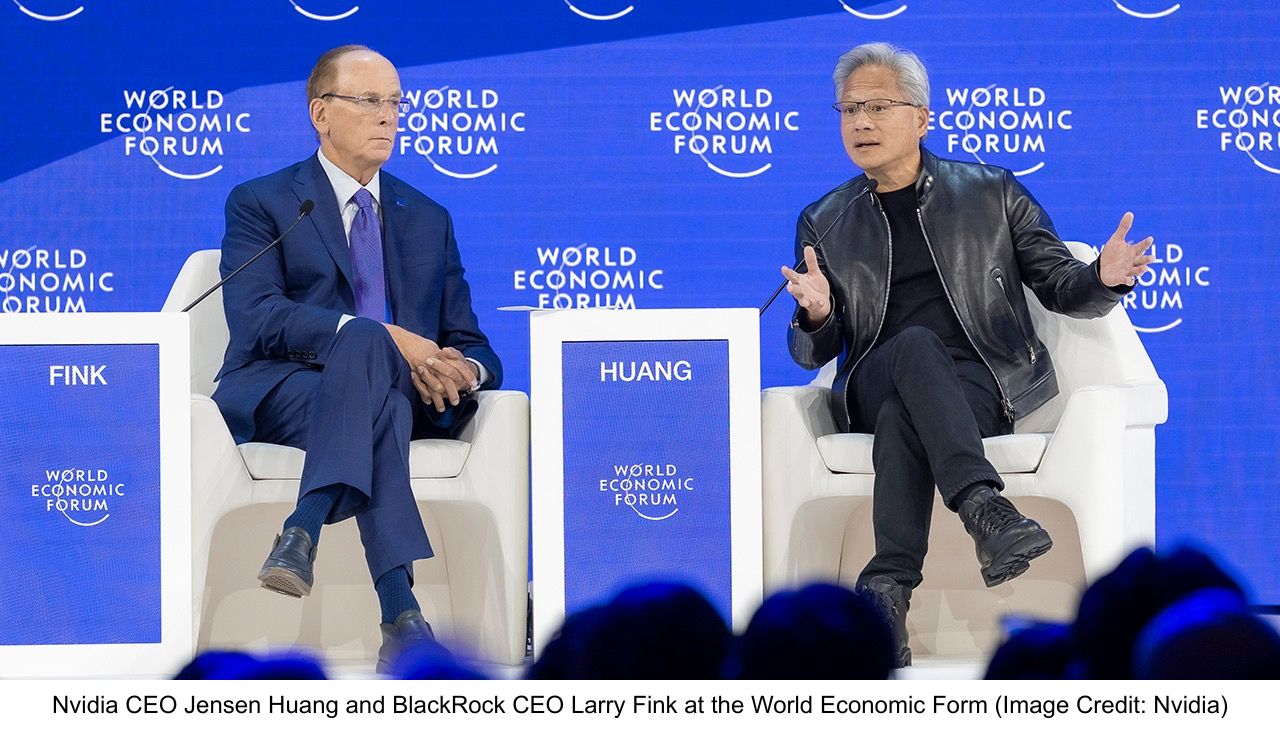
Even Nvidia CEO Jensen Huang has pointed to the indirect employment effects of AI infrastructure investment, noting that data centre construction, power generation, cooling systems, logistics, and security all represent labour-intensive activities whose demand is being driven directly by AI: employment effects that are almost entirely absent from the displacement-focused headlines most people are reading.
The Laziness at the Top
Here is what the layoff-and-automate playbook looks like from the inside. A leadership team under pressure from shareholders to improve margins identifies AI as a mechanism for justifying headcount reductions. Rather than doing the harder, more creative work of redesigning jobs, investing in reskilling, and integrating AI into workflows in a way that multiplies what their people can do, they take the path of least resistance. They cut the bottom of the pyramid, announce "AI-driven transformation," and pocket the short-term savings.
This is not strategy. This is taking a short-term gain that destroys their long-term potential. The people being displaced are precisely those who, with investment and development, would become the mid-level managers, technical leads, and institutional knowledge holders of the next decade. This disrupts the entire internal talent development process that sustains organisational capability over time.
LaMoreaux at IBM made this point directly "a reduction in junior hiring today produces a predictable shortage of experienced and business-knowledgeable staff down the line", a gap that can only be filled through expensive external recruitment. What looks like a cost-saving measure is, in structural terms, a slow act of self-sabotage, one that generates a short-term stock bump while quietly hollowing the organisation from the inside out.
The brutal irony is that the companies most aggressively cutting entry-level roles in the name of AI are frequently not the ones leading on AI capability. They tend to be organisations treating AI as a cost-reduction instrument rather than a growth engine; a distinction LaMoreaux explicitly identified "I think the productivity story has probably played out" she said."Leaders should start thinking about AI as a growth driver."
When we talk to business leaders about their AI strategy, this is often the single most important reframe we can offer them. Stop asking what AI can replace. Start asking what AI can unlock.
What AI Actually Creates
When you look at what AI genuinely does to the economy, the picture is considerably more expansive than the job-loss narrative allows.
The AI infrastructure buildout alone is generating enormous demand across sectors that have nothing to do with software. Data centres require construction, power, cooling systems, security, and logistics. LinkedIn data shows AI literacy is currently the fastest-growing professional skill in the United States, which means that demand for humans who can work alongside automated systems is accelerating, not declining. A new graduate equipped with good AI tools and sound judgment can now contribute at a level that previously required years of accumulated experience, which raises the expected return on investing in your people, not lowers it.
Whether organisations actually capture that value depends entirely on whether their leadership is willing to invest in the redesign of roles and workflows. That work requires genuine effort and imagination, but it is well within the reach of any business that is willing to approach the question seriously. It is also, frankly, the most important thing a business leader can do right now.
People Come First
At LEMA Logic, everything we do flows from one foundational conviction: technology should make people better at their work, not redundant in it. We are deeply excited about what AI can do, and we have spent years helping businesses, government agencies, and universities across North America and the Isle of Man understand and harness it. But we are deeply opposed to the way a significant number of organisations are currently choosing to use it: as cover for decisions that were always about cutting costs, dressed up in the language of innovation.
Our approach has always been to work with organisations and their teams, not to prescribe a technology solution from the outside and walk away. We want to understand their work, understand their challenges, and help them use AI to do more of what they're good at. That means training that meets people where they are. It means strategy that is tied to real business outcomes. And it means staying engaged through implementation, not just delivering a recommendation and moving on to the next advising gig.
A 2024 report from LinkedIn and Microsoft found that while 75% of knowledge workers are already using AI in some form, 60% of business leaders admit their organisations have no clear plan for implementing it. That gap is not a technology problem, and is instead a training, strategy, and leadership problem. It is the gap we close.
We've delivered over 150 hours of AI training through the Digital Isle of Man's Activate AI programme alone, reaching over hundreds of people who came in uncertain and left with practical tools they could use immediately. We've worked with university administrators, government agencies, chambers of commerce, and private sector teams of every size. In every case, the outcome we're working towards is the same: people who are more confident, more capable, and better equipped to deliver results, not people who have been replaced by a system nobody fully understands.
The companies that are choosing to invest in their people right now, rather than using AI as an excuse not to, are building advantages that their competitors will struggle to replicate when they eventually reverse course. IBM understands this. Dropbox understands this. We built LEMA Logic around this understanding, and it is the lens through which we approach every client we work with.
AI has already changed the way your people work. Now you need to decide: are you going to invest in your people or simply let the change force them down a specific path? When you decide to lead them forwards, get in touch with us at lemalogic.com/meet-lema to help.