
What the EU’s New High-Risk AI Guidelines Mean for UK and Isle of Man Businesses
LEMA Logic is a software and AI company, not a law firm or regulator. What follows is our own plain-English interpretation of the European Commission's draft high-risk classification guidelines and of the EU AI Act, written to help business leaders get oriented. It is not legal, compliance, or regulatory advice. The guidelines are still a draft, out for consultation and the surrounding rules are evolving, so this reflects our understanding as of June 2026. Before making compliance decisions, take qualified legal advice and check the primary sources linked throughout.
Navigating European Union regulations from the British Isles can often feel like trying to track changing tides from a distant shore. However, thanks to a regulatory phenomenon known as the "Brussels Effect", the European Commission’s newly released draft guidelines on the classification of high-risk AI systems may well send ripple effects directly into business ecosystems across the UK and the Isle of Man (IOM).
Even though the UK and the IOM operate outside the EU, local businesses can still be caught where they place AI systems on the EU market, put them into service in the EU, supply them into EU value chains, or provide AI outputs that are used in the EU (Article 2(1)(c) of the Act can apply even to firms with no EU establishment at all). That makes the EU AI Act highly relevant for UK and Manx software, fintech, insurance, HR-tech, and professional-services firms. Published for stakeholder consultation, these draft guidelines set out the Commission’s current interpretation of how "high-risk" AI systems should be classified under Article 6 of the landmark EU AI Act, Regulation (EU) 2024/1689.
Here is a plain-English, business-focused guide to what these rules mean for your operations, your products, and your compliance strategy.
Short on time? Start with our one-page TL;DR for developers and system owners, then come back here for the detail and worked examples.
In This Article
1. The Core Mechanics: Defining "AI" and the "Intended Purpose" Trap
2. Regulated Products: The Safety Component Conundrum
3. Stand-Alone AI in High-Stakes Environments
4. Deep Dive for the UK & Isle of Man: Fintech, Insurance, and Private Services
5. HR & Internal Operations: Recruitment and Workplace Management
6. The Exemption Filter and the Profiling Dealbreaker
1. The Core Mechanics: Defining "AI" and the "Intended Purpose" Trap
Before panicking about compliance, a business must first determine if its software even qualifies as "AI" under the EU's strict legal definition.
What Counts as AI?
The AI Act defines an AI system as a machine-based system designed to operate with varying levels of autonomy. It may also display "adaptiveness" after it is deployed and infer how to generate outputs, such as predictions, content, recommendations, or decisions that can influence physical or virtual environments. Traditional, rigid, rule-based software that simply follows a fixed set of human-written "if/then" commands does not fall under this umbrella.
The Marketing Trap: "Intended Purpose"
If your system is AI, its risk classification depends entirely on its intended purpose. This is defined by how you, the provider, describe the system in your instructions, technical documents, and marketing or sales materials.
This creates a serious trap for unwary software developers:
The General Presentation Rule: If your sales brochures or terms of service present an AI tool as "broadly applicable" across various industries and you fail to explicitly exclude high-risk contexts, the EU will assume its intended purpose includes those high-risk scenarios.
Capabilities Matter: If a high-risk use is technically feasible and reasonably foreseeable based on what your AI can do, a simple sentence in your terms of service saying "do not use this for high-risk tasks" will not save you. Limitations must be clearly, concretely, and coherently enforced across all product positioning.
Timelines: Plan for 2026, Watch the Omnibus
Under the EU AI Act as adopted (Article 113), the high-risk obligations apply from:
Annex III Systems (stand-alone high-risk use cases such as recruitment or credit scoring): 2 August 2026.
Annex I Systems (AI as a safety component of regulated physical products): 2 August 2027.
The deadlines are now set to move through the EU's "Digital Omnibus" simplification package. The Council and Parliament reached a provisional agreement on 7 May 2026 to push the dates back to 2 December 2027 (Annex III) and 2 August 2028 (Annex I). At the time of writing these new dates are politically agreed but not yet legally in force: they take effect only once the Omnibus is formally adopted and published in the EU's Official Journal, expected before August 2026. The extension is now very likely rather than speculative, but until it is published you should plan against the original 2 August 2026 date and treat the later deadlines as near-certain breathing room rather than a guarantee.
Grandfathering: Systems placed on the market before these dates are generally exempted from the rules, but this is not a blanket exemption: obligations can still be triggered if a system undergoes a substantial modification (Article 3(23)) to its design or intended purpose. Note too that prohibited practices (Article 5) and most transparency duties (Article 50) are not delayed.
2. Regulated Products: The Safety Component Conundrum
Under Article 6(1), an AI system is automatically deemed high-risk if it meets two cumulative conditions:
The AI is either a product itself or serves as a safety component of a product covered by the EU's existing product safety laws (think machinery, toys, medical devices, and lifts).
That underlying product is required to undergo a third-party conformity assessment before it can be legally sold in the EU.
The New Definition of a "Safety Component"
The guidelines emphasise that the AI Act uses its own autonomous, uniform definition of a safety component, completely independent of other sector-specific laws. An AI system is a safety component if it fulfils a safety function or if its failure or malfunction endangers the health and safety of persons or property.
What is Included: This catches standalone software, cloud applications, software updates, or add-ons. For example, if a developer builds an AI software update designed to optimise combustion efficiency in a household gas appliance, it becomes a safety component if an AI malfunction could result in carbon monoxide leaks or explosions.
What is Excluded: Purely convenient or comfort-driven features are excluded. A smart home thermostat that learns a household’s habits to reduce energy bills is not a safety component, because an AI glitch merely results in minor discomfort or a higher bill, not a safety hazard. However, if that same appliance includes an AI-driven child-lock or safety shut-off mechanism, it crosses the line into high-risk territory.
3. Stand-Alone AI in High-Stakes Environments
Article 6(2) shifts focus away from physical manufacturing and zeroes in on stand-alone AI software deployed in eight broad, sensitive areas listed in Annex III, such as biometrics, critical infrastructure, employment, and education.
The guidelines clarify two massive points of confusion for businesses operating in these fields:
Human Involvement Does Not Lower Your Risk
A common misconception among business leaders is that keeping a "human in the loop" will automatically downgrade an AI tool from high-risk to low-risk. The guidelines completely dismantle this idea.
Human involvement cannot change the fundamental purpose of the software. If the tool is designed to evaluate job applicants or student exams, it remains high-risk regardless of whether a human supervisor signs off on the final decision. Human oversight is treated as a strict compliance requirement for running a high-risk system, not an escape hatch to avoid regulation.
The "Split-Architecture" and Agentic AI Rule
The EU has anticipated clever system design bypasses. Businesses cannot circumvent high-risk classification by breaking a complex system down into a chain of smaller, seemingly low-risk modules or using interconnected "agentic AI" networks. If the combined configuration and joint outputs of these modules serve a high-risk purpose and materially influence an individual decision, the entire configuration is evaluated and regulated as a single high-risk AI system.
4. Deep Dive for the UK & Isle of Man: Fintech, Insurance, and Private Services
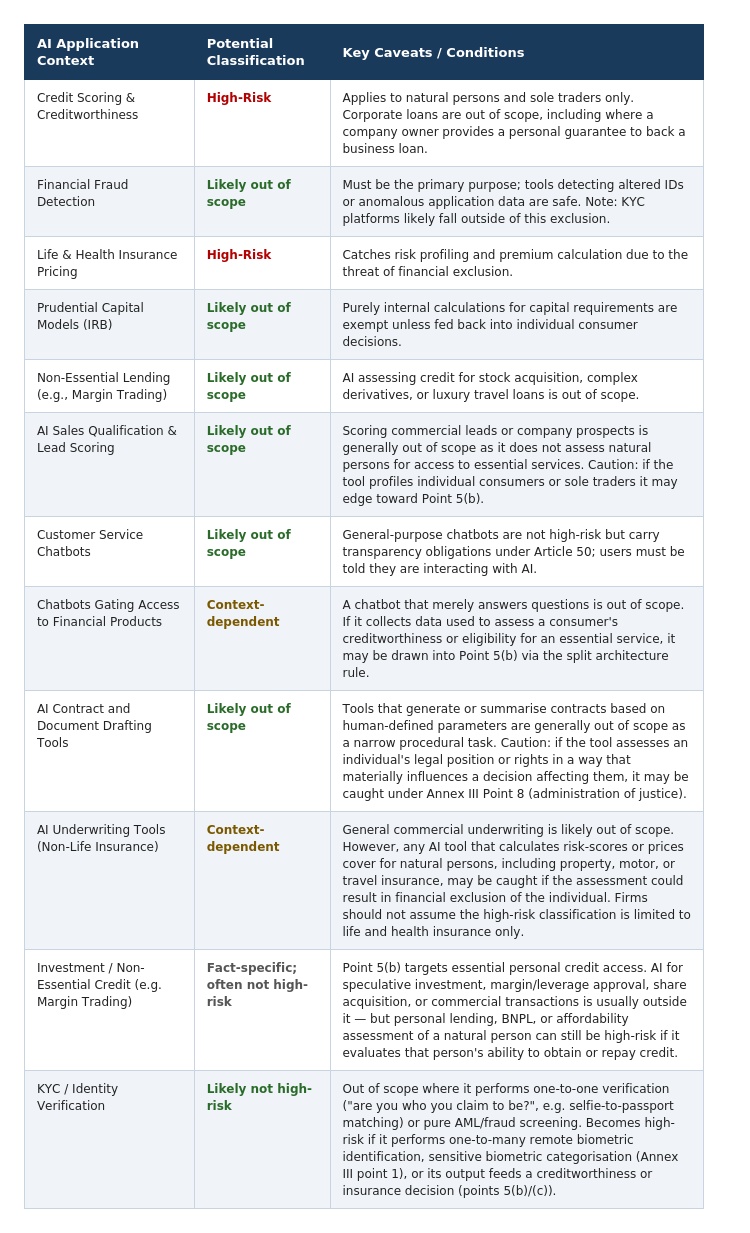
Because the Isle of Man is a globally respected hub for insurance, wealth management, and fintech, "Point 5" of Annex III (Access to Essential Private and Public Services) is potentially the most critical section for local firms.
Fraud Detection Clarification
The guidelines offer a clean exemption for tools used primarily to catch bad actors. If your fintech firm builds or buys an AI system designed to detect forged documents, modified bank statements, or identity theft patterns, it is not high-risk. To claim this, fraud detection must be the dominant, initial function of the tool, preceding any subsequent credit-scoring steps.
5. HR & Internal Operations: Recruitment and Workplace Management
Whether your business is based in London, Douglas, or Dublin, how you manage your staff using automated tools is now under intense scrutiny if your workers are within the EU.
The Recruitment Gateway
Any AI system intended to be used for the recruitment or selection of natural persons is high-risk. This includes tools that place algorithmically tailored, targeted job advertisements to specific demographic groups, software that automatically filters or parses CVs, and platforms that score or rank candidates via automated video/written testing.
The Administrative Exception: An AI system that exclusively generates a generic job description based on human-defined parameters is exempt, as it performs a narrow, low-risk administrative task.
Task Allocation & Performance Appraisals
Once staff are hired, the regulatory fence remains high. AI tools that make decisions affecting promotions, terminations, or work-related contractual terms are high-risk. Crucially, the guidelines flag task allocation tools. If an AI system dynamically distributes shifts, clients, or delivery routes based on individual behavioural traits, responsiveness metrics, or performance tracking, it is high-risk.
The Neutral Exception: Systems that allocate work based strictly on objective, neutral, external factors, such as checking if an employee has a forklift permit or matching a delivery driver purely by geographical proximity, are not high-risk.
Prohibited Workplace Emotion Recognition
This one is a step beyond high-risk. Using AI to infer the emotions of a person in the workplace or in educational settings is a prohibited practice under Article 5(1)(f) that is banned outright. The only carve-out is where the system is put in place for strictly defined medical or safety reasons (for example, detecting operator fatigue in safety-critical roles). There is no general business exemption for "engagement scoring," mood tracking, or staff sentiment analysis. Note the distinction: emotion recognition in general is treated as high-risk (Annex III, point 1), but in the workplace and education context it is escalated to an outright ban.
6. The Exemption Filter and the Profiling Dealbreaker
Article 6(3) provides a potential escape route. An AI system that technically falls into an Annex III category can be exempted from high-risk requirements if it meets at least one of four narrow conditions:
(a) It performs a narrow procedural task (such as formatting data or converting scanned files into indexable text).
(b) It improves or polishes the result of a previously completed human activity (like a grammar and tone assistant refining a human-written performance review).
(c) It merely detects patterns or anomalies in human decision-making without replacing human review (like an auditing tool flagging inconsistencies in how different teachers grade exams).
(d) It performs a purely preparatory task (such as basic document indexing or searching templates).
The Profiling Dealbreaker: There is a catch. If your AI system performs profiling on natural persons, this exemption filter does not apply.
Profiling means using automated processing to evaluate a person’s personal data to analyse or predict their behaviour, performance at work, economic situation, health, or location. If your system profiles individuals, it is automatically locked into the high-risk bracket.
Furthermore, even if you successfully qualify for an exemption under this filter, the regulatory burden does not drop to zero: you must still fully document your self-assessment and register your exempted system in the official EU database before placing it on the market, once the database is made public in August 2026.
7. Supply Chain Hazards: The "Accidental Provider" Trap
For distributors, importers, and businesses customising external AI software, Article 25(1) creates a risk. Under certain conditions, an intermediary company can accidentally inherit the legal and financial liabilities of being the primary "provider" of a high-risk AI system.
You will step into this trap if your business:
Puts its own name or trademark on a high-risk AI system already on the market.
Makes a substantial modification to an existing high-risk AI system.
Modifies the intended purpose of a low-risk or general-purpose AI system in such a way that it becomes a high-risk system.
If an Isle of Man firm takes a generic white-label generative AI tool and customises it to act as a personal creditworthiness advisor for EU clients, that firm is no longer just a user; it is legally a primary AI provider and assumes full regulatory accountability under the Act.
Your Strategic Business Action Plan
To stay ahead of the enforcement waves (currently 2 August 2026 in law, with the agreed Omnibus extension moving stand-alone high-risk systems to December 2027 and product-embedded systems to August 2028), UK and Manx businesses should take three immediate steps
Conduct an AI Inventory Audit: Review all software applications used internally or developed for clients against the EU’s autonomy and adaptiveness criteria. Identify if any fit the criteria for safety components or Annex III high-stakes environments.
Review Marketing and Documentation Clarity: Audit your product documentation, brochures, and terms of service. Ensure your software’s scope is tightly and clearly defined so you do not accidentally fall into the general-purpose "intended use" trap.
Update Vendor and Distribution Contracts: If you buy, white-label, or distribute third-party AI software, ensure your contracts clearly stipulate who holds the "provider" obligations and include explicit indemnification against Article 25 supply chain triggers.
For the deployer's side of the Act, the AI literacy and transparency duties that apply even to lower-risk use, and a practical steer on building the AI inventory described above, see Digital Isle of Man's plain-English overview at What is the EU AI Act and could it apply to you?
Need Help Navigating the EU AI Act?
Understanding how these rules apply to your specific products, services, and supply chains is rarely straightforward. If you're unsure where your AI systems sit under the new framework, or simply want to get ahead of the 2027 and 2028 enforcement deadlines, then the team at LEMA Logic is here to help. Get in touch with us today for a conversation about what these changes mean for your business.
Related: EU AI Act for Developers