Isle of Man Industry Day: Keynote
There is a conversation we have with businesses on the Isle of Man almost every single week. It goes something like this: "We know we need to do something with AI. We just don't know where to start, and frankly, we're worried about wasting money on something that doesn't actually work."
That tension is real, and it is completely justified. The pressure to adopt AI has never been louder. Barely a day passes without another headline declaring that businesses which fail to act now will be left behind. And yet, sitting across from that pressure is an equally strong instinct, a pragmatic, healthy scepticism that says “slow down, what does this actually mean for us?".
We hear that from local retailers, professional services firms, regulated multinationals based on the Island, and everyone in between. The noise is the same regardless of sector or size.
On 23 March 2026, we had the opportunity to take that conversation to a much bigger room.
LEMA Logic was invited to present “AI Tools for Small Business” at the Industry Day, hosted by Business Isle of Man and Visit Isle of Man at the Colonnade Suite in the Villa Marina. Our job on stage was straightforward: cut through the global hype, validate what businesses here are already feeling, and lay out exactly what a successful AI strategy looks like in practice, for companies like theirs, in a place like this.
Here is the case we made.
The AI Reality Check: Why Most Projects Fail
Let us start with the number that stopped the room.
According to research from RAND Corporation, a nonprofit think tank, 80% of AI projects fail outright. MIT's 2025 report goes further, finding that 95% of generative AI pilots fail to deliver any measurable business return. Nearly every hand we see raised at events like Industry Day belongs to someone who has either experienced this firsthand, knows someone who has or has seen the news reports.
So why does it keep happening despite the widespread consensus on the benefits and tangible savings of using AI?
In our work with businesses across the Island, we see the same patterns repeat themselves with depressing reliability. The first is vague goals, launching an AI initiative with no defined success criteria and no way of knowing whether it has worked. The second is tool-first thinking, reaching for a generic, off-the-shelf product and trying to force it onto a highly specific business problem it was never designed to solve. The third is data quality, or rather the lack of it. The 2026 State of Data Integrity and AI Readiness paper by Precisely found that 43% of organisations cite poor data as their single biggest barrier to AI success. You can have the most sophisticated tool in the world; if the information feeding it is inconsistent or incomplete, the output will be unreliable. The old “garbage in, garbage out” adage comes to mind.
None of this is a reason to avoid AI. Quite the opposite. These are entirely predictable, entirely avoidable traps, and understanding them is the first step to sidestepping them entirely. MIT's own research shows that specialised, partner-led implementations succeed at roughly twice the rate of internal builds. The failure rate is high, but it is not random. It has causes, and those causes have solutions.
The LEMA Logic Ethos: “The Least AI Possible"
Here is the mindset shift we brought to the stage at the Villa Marina, and it is one we come back to constantly in our work with clients.
Fall in love with the problem. Not the technology.
AI is not a switch you flip to become 20% more productive across the board. That framing is how businesses end up with expensive subscriptions, confused staff, and nothing measurable to show for it six months later. The organisations that actually win with AI are the ones that start with a specific, costly, time-consuming problem and then ask whether AI can solve it reliably.
The difference between building a habit and getting a result is also an important distinction that gets glossed over in most AI conversations. Using a tool every day is a habit. Cutting your document processing time from two days to two hours is a result. McKinsey's 2025 data makes this concrete. The organisations seeing the strongest returns from AI are the ones that redesigned their workflows before they selected their tools, not the other way around.
This is the thinking behind our GRIND framework, which we use in our consulting, and behind our principle of the "Least AI Possible."
The strategy is straightforward. Do not try to automate everything at once, and instead find your single most expensive or time-consuming bottleneck. Automate that one process. Make it completely reliable. Measure the return. Then, and only then, move on to the next.
We actively encourage businesses to chase simple, highly measurable use cases. The flashy, ambitious transformation programme makes for a good press release. The quiet process that now runs in two hours instead of two days makes for a healthy business. That is how companies on the Isle of Man, and anywhere else, actually win with AI.
So What Is Actually Working?
Frameworks and philosophies are only useful if they translate into something real. So on stage, using the MIT report as our grounding, we moved from methodology to specifics, presenting three areas where AI is delivering consistent, measurable returns right now.
Voice AI
AI telephone agents can handle inbound enquiries and bookings reliably, at scale, around the clock. LEMA Logic builds and tests these systems for Manx clients today. For businesses dealing with high call volumes or limited front-of-house capacity, this is not a future possibility. It is a live, working solution. Read more about our Voice AI solutions.
Here's the recording of the fake hotel receptionist that we demo’d:
Document Automation
The Isle of Man has a significant financial and professional services sector, and this is where document automation delivers some of its clearest wins. Contracts, compliance checks, client onboarding all involve repetitive, high-stakes document handling that is well suited to automation, with full audit trails and consistent outputs.
We see this in our own operations too. Our morning stand-up, which used to take thirty minutes, now runs as a structured two-minute report pulling together task updates, project status, deadlines, and compliance items across every system we use, fully timestamped and audit-trailed. That same logic applied to client-facing processes is where the real gains for financial services firms begin.
Code Generation
According to research by GitHub and Accenture, tools like GitHub Copilot are dramatically reducing development time and costs for businesses that rely on bespoke software. What once took weeks can be compressed significantly, freeing development resources for the work that genuinely requires human creativity and judgement.
There is a thread connecting all three of these areas that is worth naming directly, because it ties neatly into the broader theme of Industry Day. Using AI for precise, targeted efficiency does not just save time. It reduces error rates, cuts waste, and frees your people to focus on the work that actually requires a human being in the room. That is not just good business practice. It is a more sustainable way to operate.
The Human Side of AI Adoption
Getting the tooling right is only half the equation.
Businesses that adopt AI tools without investing in their people tend to end up in one of two places. Either the tools get abandoned because nobody really knows how to use them properly, or people become so reliant on the outputs that they stop applying the human judgement that catches errors and makes final calls. Neither outcome is good.
The right model is a team that understands what the AI is doing, trusts it where trust is warranted, questions it where questioning is warranted, and remains firmly in control of decisions that matter. Building that kind of confidence takes deliberate training, not a one-hour onboarding session, but ongoing, role-specific upskilling that keeps pace with the tools themselves.
For Isle of Man businesses, the good news is that local funding routes and apprenticeship pathways exist to support exactly this kind of investment. The Enterprise Support team, based here on the Island, are on hand to help businesses identify the right funding options, navigate the application process, and build a training plan that makes sense for their size and sector. Whether you are a small business taking your first steps with AI or a larger organisation looking to upskill an entire department, they are a practical, accessible first point of contact. The infrastructure is there. The question is whether businesses choose to use it.
Your Next Steps
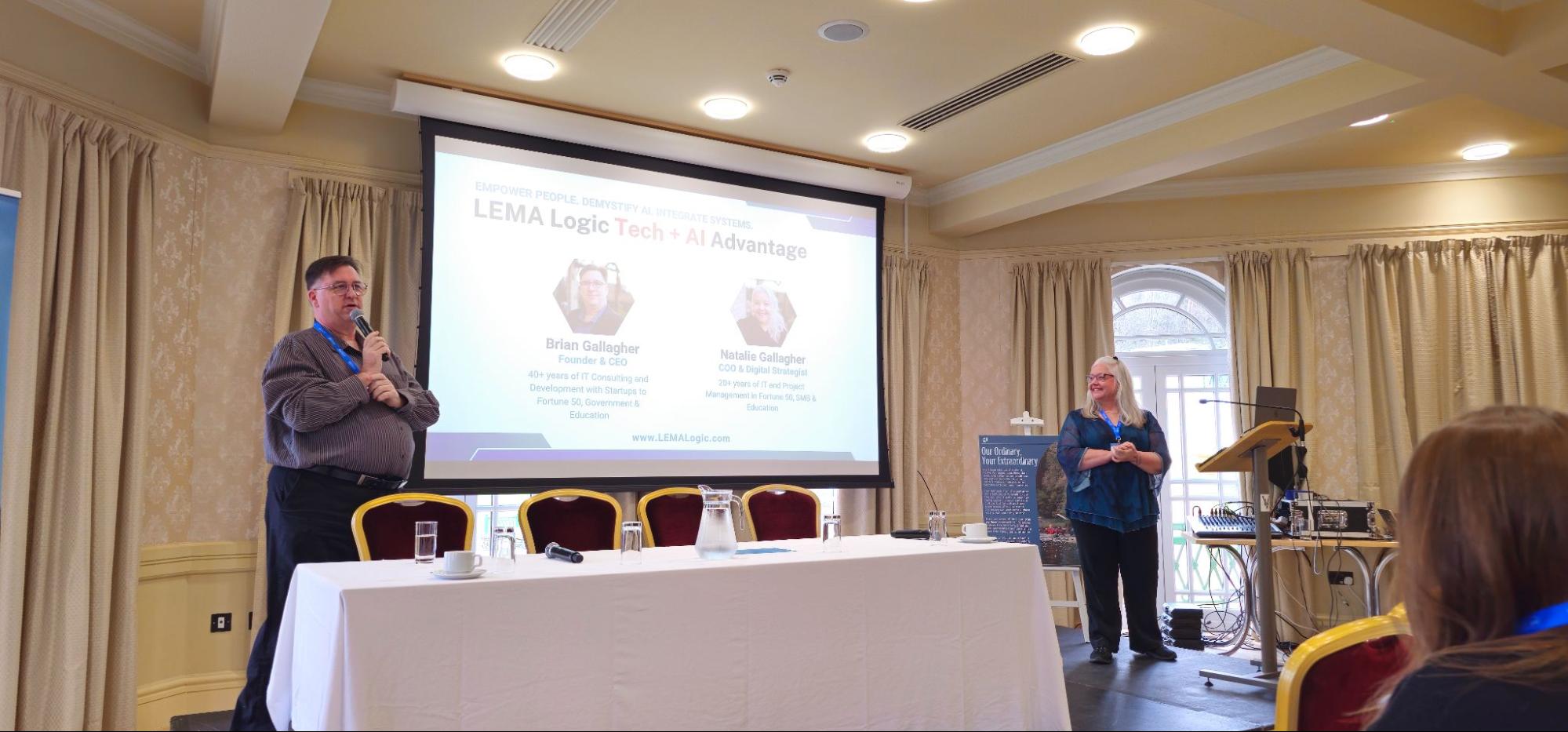
We left the Villa Marina with one message above all others that we wanted every person in that room to take away.
You do not need a massive budget. You do not need a data science team. You do not need a multi-year transformation programme with a six-figure price tag attached to it. What you need is a clear-eyed view of your biggest operational bottleneck, a structured approach to addressing it, and the discipline to measure whether it is working.
Our team brings over 100 years of combined IT and AI experience, and as a Digital Isle of Man Activate AI partner we have delivered more than 70 hours of training and built over 20 proof-of-concepts for businesses across the Island. We know what good implementation looks like and, more importantly, what it takes to make it stick. If your business is ready to find its first real AI win, we would love to help you find it.
If the conversation we started at Industry Day resonated with you, we would be glad to continue it. Get in touch at lemalogic.com/meet-lema, and let us find your first sensible, high-impact AI pilot together.