SEO in the AI Era
Search Is Changing. What It Means for Your Website.
Originally published 20 April 2026. Updated to reflect new developments in AI search.
For most of the internet's history, Google had one job: point you towards a website. You searched, got a list of links, and clicked. Traffic flowed, and businesses built complex, expensive Search Engine Optimisation (SEO) strategies around earning their share of it.
That model is under serious pressure, from two directions.
First, AI search tools have gone mainstream. ChatGPT alone had 900 million weekly active users by February 2026, according to OpenAI. Bain & Company's research finds that about 80% of consumers now rely on "zero-click" results in at least 40% of their searches, with organic web traffic estimated to have fallen 15% to 25% as a result.
Second, traditional search itself has changed. Google and Bing now show AI-generated answers at the top of many results pages, often answering the question before any links appear. Bain's research found that about 60% of searches now end without the user clicking through to another website.
Ranking well via traditional search still matters. Alongside it though, there is now a second opportunity. Your business can be the one an AI tool mentions, cites or links to when it answers a customer's question. Much of the work builds on established SEO, with some important additions around AI access, content and measurement.
This article explains how those pieces fit together, and what businesses can do now to be visible in both search results and AI-generated answers.
In This Article
Three Areas to Strengthen Your Online Presence
Make Your Content Easy to Understand and Access
SEO, AEO, and GEO Explained
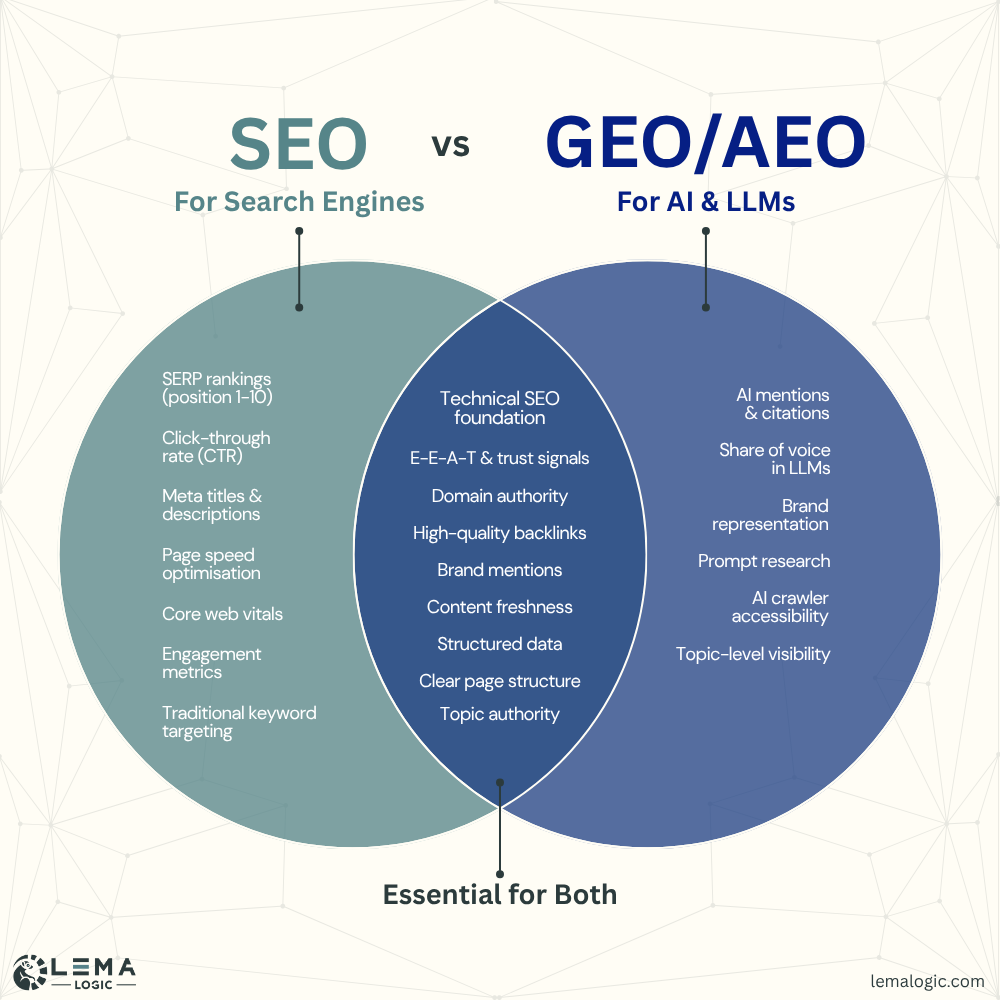
SEO, AEO and GEO are three terms you may see when people talk about search visibility. They overlap, but each puts the emphasis on a different part of how people find information.
SEO (Search Engine Optimisation) is what most businesses already know. It means improving your website's visibility in relevant search engine results.
AEO (Answer Engine Optimisation) focuses on making your content useful for direct answers, such as featured snippets and the AI-generated summaries that now appear in Google and Bing results.
GEO (Generative Engine Optimisation) is the newest of the three. It focuses on your business appearing in answers from Large Language Models (LLMs) such as Google's Gemini, OpenAI's ChatGPT, and Anthropic's Claude. Depending on the tool and the question, those answers may draw on a live web search, other sources, or what the AI learned during training.
The three are closely linked. Google itself treats optimising for its AI features as part of SEO, which is a useful reminder that the newer disciplines build on existing SEO work rather than replace it.
To see the difference in action, here's the same query, "places to visit in the isle of man", run through each:
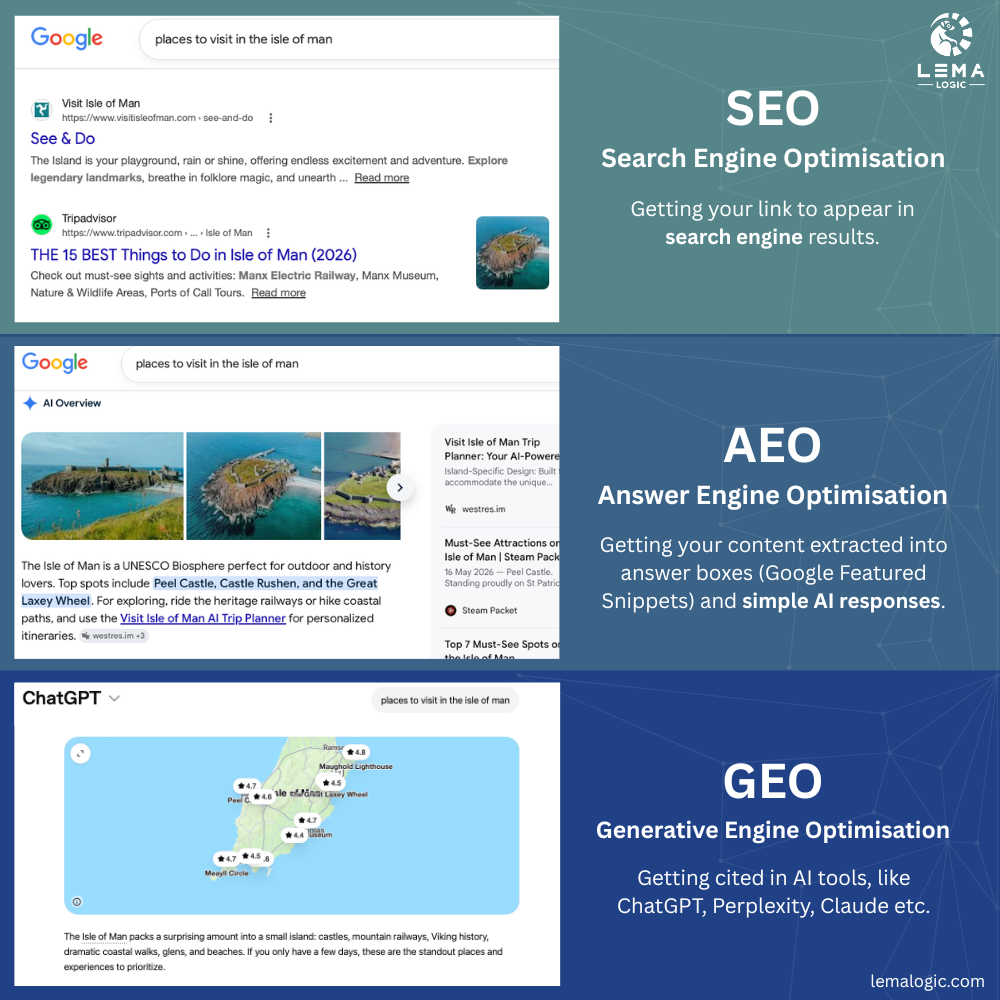
The linked sources in the AEO and GEO examples are citations. Citations are the websites the AI drew on to build its answer. For a business owner, each citation is a route from the answer to your website, and another chance to be discovered alongside the traditional listings.
Clear, useful content supports both traditional search and discovery through AI. In the AEO example above, the citations sit at the top of the page, above the traditional listings. For a relevant query, that placement can be worth more than a mid-page ranking, although the real value depends on whether it brings you the right enquiries.
Measuring What Matters Now
Before changing anything, it helps to know where you stand. Traditional measures such as search traffic and enquiries still matter. Alongside them, it is worth knowing whether AI tools mention your business, how they describe it, whether they link to your website, and whether those visitors become customers.
Brand representation is how AI tools describe your business. For a quick starting point, HubSpot's free AI Search Grader shows how ChatGPT, Perplexity and Gemini describe your brand, with no account needed. You can also check directly by asking ChatGPT, Claude, Gemini, Copilot and Perplexity the kinds of questions your customers ask, then noting whether your business appears and whether the description is accurate. Record the tool, question and date, because answers vary. A single answer or score is a snapshot, not a complete measure.
Share of voice compares how often your business appears in AI answers with how often your competitors appear, across a defined set of questions. Paid monitoring tools such as Otterly.ai track this automatically across ChatGPT, Google AI Overviews and AI Mode, Gemini, Perplexity, Copilot and Claude, showing where you feature and where you don't. Before choosing a tool, check which platforms and questions it covers and how it calculates its results.
Enquiry and conversion quality can be assessed by looking at AI referral traffic in Google Analytics, such as visits from chatgpt.com, perplexity.ai and copilot.microsoft.com, and comparing how those visitors behave with your standard organic traffic. It is worth doing. In a July 2025 study of digital marketing and SEO topics, Semrush found the average AI search visitor was worth 4.4 times a traditional organic search visitor, based on conversion rate, because AI tools often give people the information they need to decide before they click. Analytics won't capture every AI-assisted discovery, since many people read an AI answer and then search for your business by name, so ask new customers how they found you too.
For Google specifically, Search Console now includes a Generative AI performance report showing how your content performs in Google's AI features. It covers Google only, so use it alongside the checks above rather than instead of them.
Together, these give you a baseline and a clear picture of where you stand now, what to improve first, and how to tell whether the changes are working.
Three Areas to Strengthen Your Online Presence
No AI company publishes a formula for which businesses its tools mention. But the available guidance points in the same direction, towards accurate business information, content grounded in real experience, and a credible presence beyond your own website.
Verification and Data
Accurate, consistent business information remains a foundation of online visibility. Technical schema markup (standardised code added to a website's HTML) gives that information an explicit structure, helping search engines and AI tools interpret details such as your organisation, services, authors and products. Microsoft has confirmed that schema markup helps its AI models understand website content.If your website runs on WordPress and uses the Yoast SEO plugin, there is a newer option worth knowing about. Yoast's Schema Aggregation feature, developed with Microsoft's NLWeb project, brings your site's existing schema together in one place. Compatible AI tools and assistants can then retrieve it in a single request instead of piecing it together page by page. It is included in the free version of Yoast SEO as well as the paid versions, but it is switched off by default, so it needs turning on in your Yoast settings.
It won't guarantee an AI recommendation, and its value depends on which AI systems make use of it. However, it reuses the schema Yoast already creates for your site, so it is a low-effort step that builds on SEO work you have already done.
You may also hear about llms.txt, a proposed file intended to give AI tools a summary of your website. Treat it with caution. Google says it does not use these files for Search, including its AI features, and no other major AI provider has shown that it affects which businesses its tools mention. Industry studies of AI crawler traffic have found the main AI crawlers rarely request it. It does no harm, but it should not be sold as a route to AI visibility.
Human Perspective
Case studies, real opinions (like our Insights blog, for example) and original images all show what you know and how you work, from someone who was actually there. Google's own guidance for its AI features says first-hand experience and a unique point of view help content stand out, while content that simply repeats what is already available adds little. Share specific examples from your business, with permission where needed. That is something generic content, including AI-generated content, cannot provide.Digital Footprint
AI tools do not only read your website. Accurate business profiles such as Google Business Profile and Bing Places, genuine reviews, and mentions on respected industry sites and local publications all help people, and AI tools, understand who you are. Focus on places your customers already use and trust, and keep your business details consistent everywhere. Be wary of anyone offering to manufacture mentions. Avoid fabricated reviews or mentions created to manipulate search visibility.
Quality Before Quantity
A growing library of useful content can answer more of your customers' questions and give AI tools and other websites more to reference. But publishing more often does not, by itself, guarantee better rankings or more AI citations. Thin, repetitive content, or "AI slop" as it has come to be known, does the opposite.
Quality and relevance matter more than volume. Start with the questions your customers actually ask, and answer them from real experience. Where several articles cover related subjects, organise and link them, with an overview page leading to more detailed articles, so visitors can move easily between them.
If you use AI to help create content, a person needs to check the facts, sources and business details before anything is published. AI writing tools draw on the wider web, which contains plenty of false or misleading information. In its August 2025 audit, NewsGuard found that 10 leading AI chatbots repeated false claims about news topics 35% of the time, nearly double the 18% rate of a year earlier. Once inaccurate content is on your website, it becomes part of your public record.
Human review (or "human-in-the-loop", as we now call it) is what separates a useful AI-assisted workflow from a reputational risk.
Make Your Content Easy to Understand and Access
Clear structure helps visitors use your website, and helps search engines and AI tools interpret it. The five practices below are sound foundations rather than a formula for earning AI citations.
1. Modular Structure
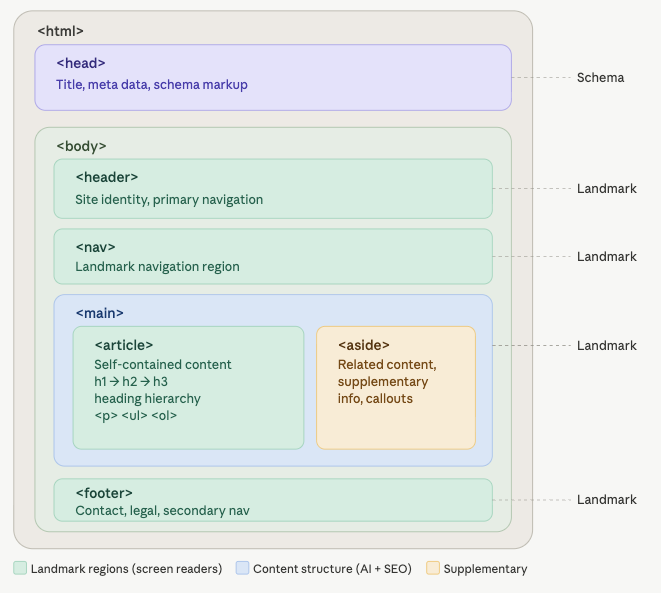
Break each page into clearly labelled sections with descriptive headings, so readers and AI tools can find what they need. Behind the scenes, use semantic HTML. This is code that tells browsers and other systems what each part of the page is, such as marking a navigation menu as navigation, or a quote as a quote, rather than relying on visual styling alone. It also helps people using screen readers and other assistive tools. The diagram below shows what this looks like in practice.
2. Direct Responses
Answer your customers' questions clearly and early, then add whatever detail is needed. FAQs and a table of contents can help where they suit the page. There is no required answer length or special format. Google, for example, says there is no ideal page length and no need to break content into small chunks for AI.
3. Images, Video and Supporting Text
Give informative images alternative text, add captions to videos, and provide transcripts where useful. These improve accessibility and give search engines and AI tools more context. Avoid putting information customers need only inside an image or video.
4. Make Sure AI Tools Can Reach Your Site
Allowing relevant AI search crawlers to access your website helps your own content become available for search answers. OpenAI, for example, says that sites blocking OAI-SearchBot will not appear in ChatGPT search answers, although they may still appear as navigational links. Check that your robots.txt file allows the search crawlers you want to reach your pages. Access for search and permission for AI training are separate settings.
If your site uses Cloudflare, check its AI bot settings too. Cloudflare now provides separate controls for search, AI training and AI agents, and its defaults have changed over time. Security settings can block a crawler even when your robots.txt file allows it, so check both rather than assuming your site is accessible.
5. Traditional SEO
Alongside structured content, the traditional SEO fundamentals still matter. Page speed, mobile responsiveness, core web vitals (which measure how quickly and smoothly your pages load for visitors), and clean site architecture all continue to be essential. The AI features in Google and Bing draw on those search engines' own indexes, so the foundations that help you rank also help you appear in AI answers. The technical foundation is not optional background work. It is the bare minimum for everything that follows, although meeting it makes your content eligible to appear rather than guaranteeing that it will.
You Probably Don’t Need to Start From Scratch
If your business already has an established website, the work needed may be less than you think. A focused review can show where to clarify your services, update business information, answer the questions customers actually ask, and fix anything stopping search engines or AI tools from reaching your pages. A full SEO overhaul is not always the answer.
If your site runs on WordPress with Yoast SEO, the review can also check whether Schema Aggregation is enabled, and whether your underlying schema is complete and accurate enough to be worth sharing. The baseline from the measurement steps above then shows you what to change first and whether the changes are working.
Much of what makes a site rank well in traditional SEO (technical foundations, trust signals, structured data and genuinely useful content) also makes it easier for AI tools to find, understand and cite. That overlap is where the work you have already done keeps paying off. Newer tools and techniques are worth assessing on what they actually do and which AI systems support them.
Your Path Forward
The technical landscape will keep changing as it always has, even while the speed of change has accelerated due to AI. But the core principle that determines digital success stays the same. Give people looking for what you offer the most useful, credible and accessible information you can.
What is expanding is the range of ways that information reaches people, i.e. traditional search results, AI-generated answers and conversational tools.
Businesses that navigate this well are the ones building a clear, structured strategy and treating their digital presence as a long-term asset, not chasing the latest AI feature set.
That requires thought, consistency, and the right guidance. It does not need to be complicated, but it does need to be deliberate.
To find out more about how we can help your business thrive in the age of AI, book a free, no-obligation discovery call at lemalogic.com/meet-lema.