AI Makes the Hard Jobs Harder
The Hidden Cost of AI Productivity
Artificial Intelligence (AI) promised us a productivity revolution. AI would handle the grunt work, freeing us to focus on the higher-value tasks. Strategic thinking. Creative direction. The work that actually moves the needle in business.
And it worked... just not the way we expected it to.
It did get rid of the easier work, and left us only the harder work, and more of it.
Oops.
It Wasn't Just "Grunt Work" - It Was Mental Rest
If you have been using AI for a while in your core workflows, you're probably feeling it already... that "I'm way more mentally exhausted than I used to be" feeling at the end of the day. Needing to get up and walk around more times than you used to do.
You're not alone.
Here's the part we didn't factor in. Those "low-value" tasks that AI now handles for us: googling for data, writing routine emails, reading web pages for ideas, formatting documents, basic research... it turns out that they weren't just wasted time or filler in your day. They were actually providing the mental breaks needed between working on the hard things, that high-value stuff we wanted more time for.
"Those 'low-value' tasks weren't just wasted time.
They were the mental breaks between the hard things."
- Brian Gallagher, CEO, LEMA Logic
Our "cognitive load density" has increased. Based on observations from working deep in AI-augmented workflows, the average knowledge worker used to spend roughly 30-40% of their time on high-cognitive tasks requiring intense focus and concentration, with the rest spent on more routine or mundane tasks that could be completed without high focus. Now, with those "boring" tasks automated, the estimate is that we're spending 80-90% of our time in highly-engaged, hyper-focused work that requires full attention.
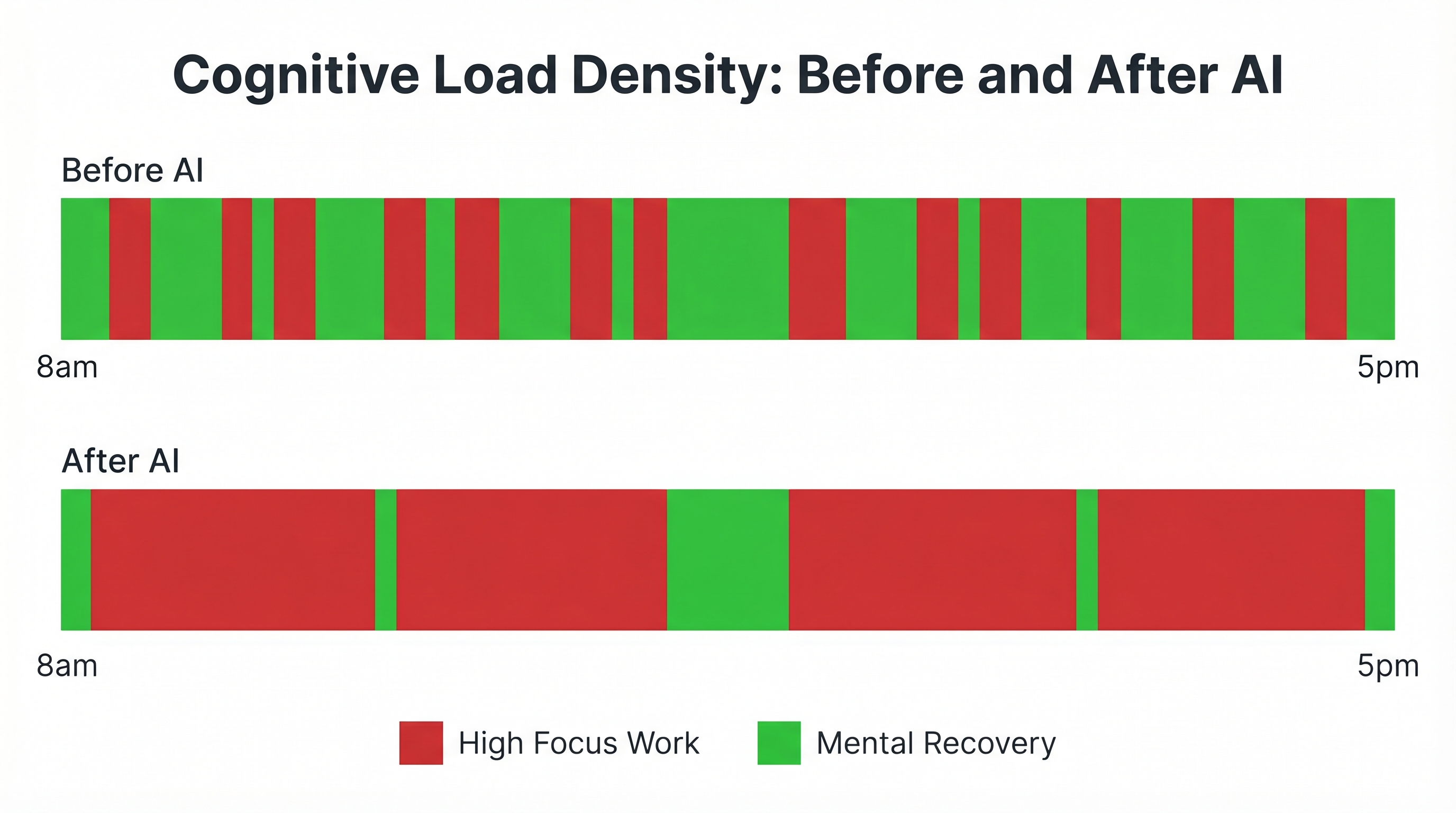
But we aren't getting any of this "free time" back.
We aren't getting more mental downtime to rest and reset our minds.
Combine this with new prompt-driven workflows that look like this:
We enter a prompt in Window 1 and the AI agent goes off and does its thing for a few minutes.
While we wait, we go to Window 2 and enter another prompt to kick off something on another task or in another project, and that agent goes off and starts working.
Repeat with Window 3.
About this time, Window 1's agent is probably just finished up and is showing its results. You then have to read the results, answer any questions it may have, and provide it the next task. Repeat this process for Window 2 and Window 3 and start over again.
Not only are you doing the same high-focus work you would have done before AI, you are now doing three-times as much mental work, having to quickly task-switch in your mind whenever you change windows, and you repeat this all day long.
What we are left with is an unbroken stream of analysis, strategy, decision-making, creative direction, and quality judgment. Your cognitive load density has doubled or tripled, and we are expected to get a lot more done in the same amount of time.
Our minds are good at fast intense sprints, or slower, longer routine or "boring" tasks. We aren't made for "marathon sprints" where we go at full speed, all day long.
We're at risk of burning out if we don't intentionally put mental breaks into our processes.
A Real-World Example
To illustrate the point, our CEO and co-founder Brian Gallagher describes his AI-driven workflow in his own words on his Substack, Pressure Tested.
He is currently:
Building a new Drupal-based website installation for a site migration with complex data relationships, custom layout and branding as one task in one window,
Reviewing an AI model's security implications and writing a blog post about it as another task in another window,
Analysing enterprise AI ROI reports and comparing them to research used in presentations last year,
Planning a social media campaign for an academic research paper, and
Managing Asana tickets and associated infrastructure across all of these.
As soon as one prompt is finished for the next iteration, it's on to the next, in a cyclic loop of always-hard-analysis work, nonstop and uninterrupted by the easier things that would have previously been done by hand.
Constantly task-switching between not only different projects, but between entirely different types of work. And it's a treadmill that never stops. When one task finishes, another gets pulled into the workflow from the next Asana ticket in the queue.
Those old easy tasks that AI has "helped" with weren't just filler. They were cognitive rest stops.
Googling for something gave the brain a few minutes to process the last hard decision before the next one. Writing a routine email by hand was a low-stakes activity that let the analytical mind idle a bit. Reading a web page was passive intake, not active output. Improved AI workflows eliminated most of that. What's left is a marathon sprint without breaks between laps.
Brian Gallagher has been building and breaking technology for over 45 years and has never experienced anything like this sustained cognitive intensity. And he chose this. He runs an AI consultancy and is all-in on this technology, deliberately pushing it harder than most people would, to learn where the limits are, where it breaks down, and how to create sustainable, enjoyable workflows for people.
But the research shows even moderate AI users are hitting the same wall. For people who had AI dropped into their workflow by management decree, the effect can be disorienting, and it's important that we understand it and prevent the problems it could cause: burnout, attrition, and lowered quality of decisions from mental fatigue.
The Research Is Catching Up
It's not just anecdotal. Research is being done and the evidence is starting to pile up.
Harvard Business Review identified three intensification patterns in February 2026:
Scope expansion (AI lets you do more, so you do more)
Dissolved stopping points (natural task boundaries disappear)
Parallel threads (multiple work streams running simultaneously)
That maps precisely to the pattern above.
UC Berkeley Haas researchers found the opposite of what AI vendors promised. AI didn't free up time, it consumed it differently and often more intensely.
Fortune reported recently that time spent emailing had doubled, focused work sessions fell 9%.
"Not a single activity category where AI actually saved time."
- Fortune, March 2026
IT Pro found teams facing "unsustainable" workloads, cognitive strain, and burnout directly attributed to AI-augmented work.
Stanford's 2026 Artificial Intelligence Index Report, 385 pages of data from the most comprehensive annual survey in the field, landed on the same findings from yet another angle.
Productivity gains from AI are "largest in structured, measurable work where outputs are easy to monitor":
Customer support (14-15%)
Software development (26%)
Marketing output (50%).
But "gains are smaller in tasks requiring deeper reasoning, and recent evidence raises concerns that heavy AI reliance may carry long-term learning penalties that slow skill development over time."
The easy stuff gets automated. The hard stuff gets harder. And the people who lean on AI for the easy stuff may be losing the ability to do the hard stuff when they need to.
And the American Enterprise Institute's report on de-skilling the knowledge economy points to something even bigger. As AI takes over the routine cognitive tasks, the only thing left that has real market value is what they call "tacit judgment", the gut instinct, the contextual awareness, the experience-based decision-making that you can't automate. The easy stuff isn't just disappearing from your schedule... it's disappearing from the job market entirely. What's left is the hard stuff, it's worth more than ever, and there's more of it than ever. And we're expected to do it all day, without the mental breaks we used to get for free.
What To Do About It
The answer isn't to stop using AI. That ship has sailed, and honestly, AI is the most powerful tool most of us have ever worked with. But we do need to be intentional about how we adapt to it, rather than just absorbing the intensity and pretending we're fine.
Recognise the pattern. If you're exhausted at the end of an AI-augmented workday despite "getting more done," this is probably why. You're not imagining it. Your brain has been running at full capacity for eight hours straight because the natural rest periods that used to be built into your day are gone.
Deliberately schedule recovery. Those cognitive rest stops used to happen on their own. Now we need to create them intentionally. Walk away from the screen between hard tasks. Do something with your hands. Let your brain idle for a bit. This isn't laziness. It’s the routine maintenance that your brain needs to run at peak performance.
Resist filling every free minute. When AI saves you 30 minutes on research, the temptation is to immediately start another hard task. Sometimes you should. Sometimes you should stare out the window for fifteen minutes instead or take a walk to the break room and chat with a coworker. Your afternoon self will thank you. And your management will thank you (or should, at least) as the long-term quality of your decisions remains steady, instead of declining as you burn out.
Rethink productivity metrics. Organisations measuring output per hour are going to be using the wrong metric. When every hour is max-intensity cognitive work, raw output is a burnout metric disguised as a performance metric. We need measures that account for sustainable cognitive load, decision quality over time, and long-term capacity, not just throughput. Mental breaks need to be supported and enforced.
The Reality Check
This isn't a complaint. LEMA Logic is building its entire business around AI. The team is more capable than ever, shipping more work at higher quality across more domains simultaneously. The technology is genuinely transformative.
But we need to be honest that AI is changing the nature of work in ways we didn't anticipate. The "productivity" narrative isn't manifesting quite how we expected it to. It's not making work easier. It's making the easy work disappear, which makes the hard work harder because people are not made for extended, high-intensity mental work being done without breaks all day long.
"Cognitive load density is the hidden cost of the AI productivity revolution."
- Brian Gallagher, CEO, LEMA Logic
The sooner we name it, the sooner we can manage it.
This doesn't mean we shouldn't take advantage of the power of AI, but it does mean we should manage that power, and the resulting additional responsibility that comes from using it, responsibly. It doesn't improve productivity to burn out your most productive workers, have them leave via illness or attrition, and be left with high-demand roles that are hard to fill, because they require skills and experience specific to your business and how it operates.
There's another angle to this that we haven't fully reckoned with yet. All that "busy work" that AI eliminated? It wasn't just rest for experienced workers. It was training for junior ones.
How does a new hire learn how the business actually operates? By doing the grunt work. Reading through old emails to understand client relationships. Formatting reports and learning what the numbers mean along the way. Googling industry terms and slowly building a mental model of how everything connects.
That's the apprenticeship. That's how tacit judgment gets built. And we just automated it away.
So now we have a workforce that needs experienced judgment more than ever... and we've removed the pathway that produces it. That's a problem we haven't solved yet, and it's coming fast.
If you haven’t already, take a look at our hot take on why AI isn’t the job destroyer, but lazy leadership is and how certain forward thinking companies like IBM are attempting to address this problem.
Build new workflows for machines and for people. As the technology adapts, the people and corporate culture and expectations and metrics must adapt as well. When things change, everything else changes around it. Plan for this and build in the support your people and systems will need, and be flexible to see when those needs change and adapt.
Stanford's data backs this up with numbers that should worry anyone running a team. Employment for software developers ages 22-25 has fallen nearly 20% from its 2022 peak, even as headcount for older developers continues to grow. The same pattern shows up in customer service. The entry-level jobs that used to train the next generation of experts are disappearing first. And 73% of AI experts expect AI to have a positive impact on jobs, compared to just 23% of the public. A 50-point gap between the people building it and the people living with it.
The Real Shift
AI didn’t make work easier. It removed the parts of work that gave us room to think. We need to put that time back into our workflows.
What’s left is continuous decision-making, analysis, and judgment. The hardest parts of the job, compressed into every hour of the day. We need to protect our ability to make these high-value decisions.
Output has increased. The research is clear on that. But so has the intensity of the work required to produce it. We need to find new ways of measuring performance rather than sheer output quantity.
Studies are now showing the same pattern from multiple angles. More parallel work, fewer natural stopping points, and higher cognitive strain, with little evidence of real time being given back. Some of that time needs to be kept for recuperation.
That’s the shift. More output, but at a higher cognitive cost. More capability, but less recovery. Build in the recovery as part of the process.
The organisations that recognise that will adapt how they measure performance, structure workflows, and support their teams. People need to be supported to prevent burnout and attrition.
The ones that don’t will keep chasing productivity gains and burn out the people those gains depend on. Those that take care of their best people doing the highest value work will succeed the most.